
At its 25th anniversary, the story of the Bank Deposit Guarantee Fund (hereinafter referred to as FGDB) was perceived as a series of adventures through Dumas’s filter; now, at FGDB’s 30th anniversary, the adequate paraphrase comes from Homer: it is not the journey that matters, but the return. The Homeric odyssey is not the story of aimless wandering, but of a homecoming: after twenty years of war and seafaring, Ulysses returns to Ithaca, to the same landmarks, yet enriched by the experience of the journey. The 30th anniversary of FGDB’s establishment offers an opportunity for such a retrospective look at an institution that had repeatedly extended its functions without ever changing its fundamental purpose.
This article aims to show how, after three decades in which almost everything around it changed – the banking system, the regulatory framework and the boundaries of its own mandate – FGDB has remained anchored to the same “Ithaca”: depositor protection.
The Odyssey of the 1990s
During the tumultuous 1990s, Romania’s situation mirrored that of other countries in the former Eastern European communist bloc; the nation grappled with challenges stemming from the difficult transition to democracy and a market economy, as well as the fragility of its financial and banking system, insufficiently developed and regulated for the new competitive landscape and subsequently “reshaped” by market forces through a wave of bankruptcies. The transition to a market economy began late and proceeded gradually and with difficulties, thus impacting the reform of the economic, political and social systems. Following the 1989 Revolution, which marked the end of a totalitarian regime, Romania’s economy lacked the necessary leverages to shift to a genuine market economy. Major challenges included the lack of reforms, the uncompetitiveness of domestic products, outdated technology, bloated enterprises plagued by poor management, financial gridlock, socio-political tensions and an inefficient judicial system.
From the onset of the transition to a market economy until 1997, reforms proceeded at a relatively slow pace. Programs for the privatization, restructuring or liquidation of unviable, loss-making enterprises were not initiated until 1995. The slow pace of structural reforms led to an accumulation of imbalances, exacerbated by the governing authorities’ contradictory and unpredictable policies, resulting in a deterioration of the economic and financial situation. That decline was evidenced by rampant inflation, significant depreciation of the national currency, a recession beginning in the last quarter of 1996 and major difficulties in servicing external debt. Turbulent external conditions – marked by global and regional economic and financial crises, including the war in the former Yugoslavia (which caused Romania substantial trade losses due to disrupted bilateral trade and the Danube trade embargo) – combined with the pressure of servicing external debt accumulated since 1990, led to an explosion of domestic imbalances in late 1998.
The 1990s also saw significant levels of impoverishment, with the poverty rate standing at 22% in 1994, according to the World Bank estimates. Poverty intensified sharply during the transition period; according to the World Bank’s Poverty Assessment Report from November 2007, the economy experienced a decline between 1995 and 1999 that was directly reflected in rising poverty levels, peaking at 35.9% in 2000. Against a backdrop of poverty and a lack of financial literacy, pyramid schemes and pseudo-mutual funds emerged – particularly between 1991 and 19951 – and their subsequent collapse undermined Romanians’ confidence in the financial institutions as a whole.
The banking reform began in Romania a little later than in most Central and Eastern European countries and was heavily shaped by the legacy of a totalitarian regime that had been far more severe than those in other communist-bloc states. Developing an appropriate regulatory framework and building expertise in banking supervision posed additional challenges to the reform’s implementation. A failure to adhere to prudential principles in lending activities was the primary cause of the problems banks faced during the 1990s. Non-performing loans sometimes vastly exceeded the banks’ own capitals. Real prospects for recovery were minimal, making banking consolidation the only viable solution. The consolidation process via recapitalization was launched in 1997 – with some delay compared to other former communist-bloc countries (for instance, Hungary began the process in 1992) – against the backdrop of the deteriorating financial condition of Bancorex and Banca Agricolă. Despite the efforts made, the recapitalization measures failed to yield the expected results, as they were not accompanied by an operational restructuring of the banks in question.
At the beginning of the transition period, in 1991, Romania’s first private banks were established under Law No. 31/1990 on commercial companies (Dacia Felix SA and Renașterea Creditului Românesc – Credit Bank SA). After only a few years of operation, those banks faced difficulties and a steadily deteriorating financial position – despite interventions by the central bank – eventually reaching the point of insolvency. To avert a crisis amidst a severe erosion of public confidence in the banking system and the absence of a guarantee scheme to protect depositors’ savings and maintain financial stability, the National Bank of Romania was authorized by law2, in its capacity as lender of last resort, to grant loans to each of the two banks for covering public requests for withdrawal of deposits held with them, up to a ceiling of RON 1,000 per depositor – excluding accrued interest – regardless of the deposit currency or the number or size of the deposits.
The Emergence and Evolution of FGDB
In 1996, as part of the measures package agreed upon with the International Bank for Reconstruction and Development regarding financial sector reform in Romania, the foundation for the deposit guarantee scheme was laid down through the Government Ordinance No. 39/1996 on the establishment and operation of the Deposit Guarantee Fund in the Banking System, which entered into force on August 30, 1996. FGDB became operational in November 1996, benefiting from the support of the National Bank of Romania in drafting the initial regulations governing its field of activity. By the end of its first year of operation, FGDB had 40 member banks, of which 30 Romanian legal entities and 10 branches of foreign banks.
FGDB was thus established for reasons of financial stability – amidst the challenges faced by the Romanian economy and the banking system in the early 1990s – and in response to international developments regarding deposit guarantee. Initially, FGDB’s mandate was limited to guaranteeing deposits held by individuals and paying compensations to eligible depositors of banks authorized by the National Bank of Romania to accept deposits. Over time, the potential for FGDB to play a more complex role within the banking sector was recognized; consequently, legislation enacted in 2001 regarding credit institutions’ bankruptcy provided for the possibility of appointing FGDB as judicial liquidator3 – a role it assumed a year later, in 2002, for two failed banks (Banca Română de Scont SA and Banca Turco Română SA).
Starting 1996, along with FGDB’s establishment, Romania began the gradual implementation of the European Directive 94/19/EC on deposit guarantee schemes, a process that lasted until July 2004. The nature of actuivity of deposit guarantee schemes had undergone continuous development and consolidation over time, with the 2008 financial crisis marking a turning point. That was the moment when the role played by these institutions in ensuring financial stability was recognized and reinforced, including through their involvement (via structures that vary from country to country) in the financing and implementation of bank resolution measures.
Depending on the mandate conferred by law or the Articles of Association, the complexity of deposit guarantee schemes ranges from providing compensation payments in the event that deposits become unavailable, to direct involvement in financing and managing the implementation of resolution measures – as decided by the resolution authority – and/or managing various categories of funds (deposit guarantee funds, resolution funds, investor compensation funds).
In the context of the development and increasing complexity of operations performed by deposit guarantee schemes, and of the opening up and cooperation within the financial sector, the Directive 2014/49/EU on deposit guarantee schemes had been issued at the European level to ensure a unified and level-playing field regulatory framework, its provisions being transposed into the national legislation of every European Union Member State. With the rapid growth of cross-border banking services, collaboration among all bank deposit guarantee schemes became a key factor in their operations. At both European and global levels, deposit guarantee schemes had established two specialized associations – the European Forum of Deposit Insurers (EFDI) and the International Association of Deposit Insurers (IADI) – which, by virtue of their mandates, now play a decisive role in setting the standards underpinning the operation and cooperation of deposit guarantee schemes. FGDB is a member of both associations, having been among the first deposit guarantee schemes to attain this status.
Developments regarding the operations of deposit guarantee schemes at European and international levels led to the adoption of a new regulatory and operational framework for FGDB. The responsibilities conferred by law4 had become broader and more complex; as of late 2015, FGDB (renamed the Bank Deposit Guarantee Fund)5 became the officially recognized statutory deposit guarantee scheme in Romania, as well as the administrator of Romania’s bank resolution fund, following the transposition into national law of the European framework for the recovery and resolution of credit institutions.
Currently, FGDB falls into the category of deposit guarantee schemes with an expanded mandate of powers and responsibilities. In addition to its functions regarding deposit guarantee and the administration of the bank resolution fund, FGDB may also carry out activities related to the National Bank of Romania’s implementation of bank recovery (early intervention) and resolution measures; it can thus act as a temporary administrator for a credit institution undergoing recovery, a special administrator for a credit institution under resolution or a shareholder in a bridge institution or an asset management vehicle. Should a participating credit institution be subject to a resolution measure, FGDB is legally required to contribute to the respective measure’s financing with an amount determined by the National Bank of Romania in its capacity as resolution authority.
FGDB also serves as the sole liquidator of credit institutions in cases of administrative liquidation (whether the National Bank of Romania orders dissolution followed by liquidation or liquidation takes place at the shareholders’ initiative) and will continue to exercise the duties associated with its mandate as judicial liquidator – conferred in 2002 for Banca Română de Scont SA and Banca Turco Română SA – until the conclusion of their respective bankruptcy proceedings6.
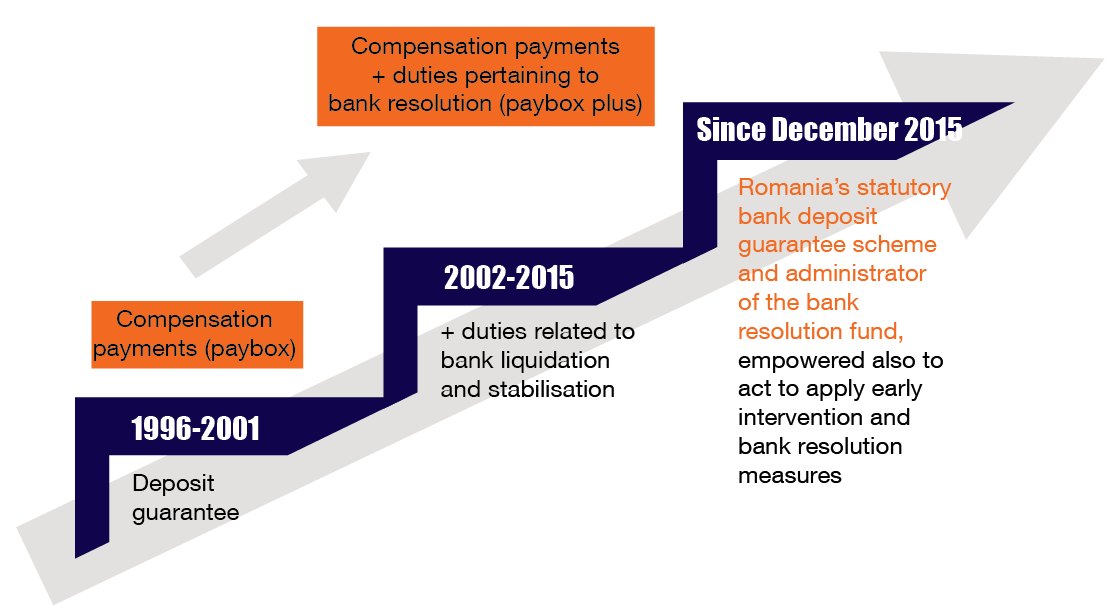
Evolution of FGDB’s responsibilities
Given the responsibilities conferred by the current legislative framework regarding its contribution to maintaining financial stability, FGDB holds observer status within the National Committee for Macroprudential Oversight, which comprises representatives from the National Bank of Romania, the Ministry of Finance and the Financial Supervisory Authority.
Amidst the continuous enhancement of depositor protection, FGDB has consistently fulfilled its primary objective of guaranteeing deposits throughout its 30 years of operation, always honoring its obligations to eligible depositors. A constant priority was the payment of compensations within the shortest possible timeframes, in accordance with both legal provisions and practices in other Member States, as an essential element for maintaining depositor confidence in the banking system. To this end, the legislative amendment of December 2015 enabled Romania to rank among the Member States with the shortest deadline for the payment of compensations, namely 7 working days, without availing itself of the transition period until 2024 provided for by the Directive on deposit guarantee schemes.
In the context of the relationship with depositors in the era of digitalization, an increasing number of guarantee schemes across Europe are utilizing their own platforms to ensure compensation payments to guaranteed depositors. Aligning with this trend, FGDB has initiated a strategic project to identify and implement compensation payment methods that serve as alternatives to the existing system involving paying agents (mandated banks).
Furthermore, the scope of deposit guarantee has gradually expanded since FGDB’s inception, in line with the harmonization of relevant European legislation. The most recent expansion took place at the end of 2015; currently, deposits held by all individuals and enterprises, regardless of the latter’s size, are guaranteed.
The compensations that FGDB would grant in case of deposits’ unavailability, up to the coverage limit of €100,000 in RON equivalent7, represent a crucial aspect of its role in maintaining financial stability by upholding depositors’ confidence in Romania’s financial and banking system, while also fostering a sustainable increase in savings rate.
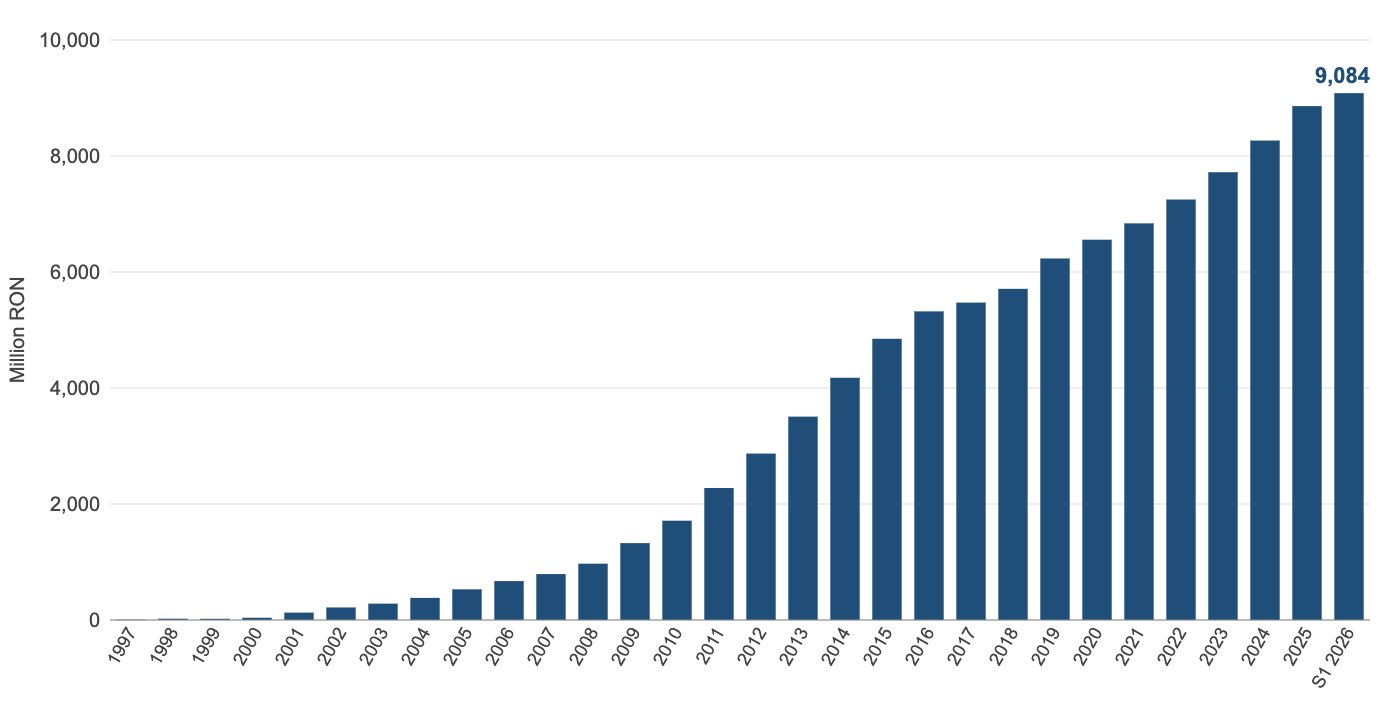
The resources accumulated in the bank deposit guarantee fund, intended for payment of compensations and the financing of resolution measures, have maintained a steady trend of systematic growth, thereby strengthening the capacity to finance the measures mandated by law regarding deposit guarantees and bank resolution. By the end of the first half of 2026, the resources accumulated in the deposit guarantee fund totaled approximately RON 9.1 billion, an adequate level for financing the measures for which the fund is intended. Since its inception, FGDB has employed an ex-ante financing mechanism, enabling the gradual and steady accumulation of resources, particularly given that these funds have not been utilized in Romania since 2007 for the specific events they are designed to cover. Consequently, FGDB currently ranks among the schemes with a high degree of resource adequacy relative to the European Union requirements, namley a target level of 0.8% of total covered deposits, with the ratio of the guarantee fund’s resources to the volume of covered deposits standing at 2.56% as of June 30, 2026.
The primary funding sources for the deposit guarantee fund are risk-based contributions of participating credit institutions and FGDB’s accumulated annual net profits, reinvested in proportion of at least 99% to augment available financial resources.
Evolution of the deposit guarantee fund from its inception to 30 June 2026
At the same time, since 2019 FGDB has initiated measures to implement alternative financing mechanisms that would enable it to secure, on short notice, the funding necessary to meet its legal obligations. Thus, under a pilot program designed for deposit guarantee schemes, FGDB contracted a stand-by loan of preventive nature from the International Bank for Reconstruction and Development for a five-year term, as an integral part of ensuring the proper management of its financial resources.
For cross-border compensation payments, FGDB acts as a paying agent for the deposit guarantee schemes in the home Member States of credit institutions having branches in Romania. In the implementation of the EU’s provisions regarding cross-border compensation payments, a Multilateral Cooperation Agreement among European Union deposit guarantee schemes8 – drafted under EFDI’s umbrella and validated by the European Banking Authority – had been concluded in the fall of 2016, with FGDB being one of the initial signatories. Since 2018, FGDB is being also participating in EDDIES9, a secure, centralized system developed at the European Union level to provide the necessary infrastructure for both the exchange of information between deposit guarantee schemes and the execution of cross-border compensation payments.
At international level, in recent years FGDB has enhanced its engagement and collaboration with the field professional associations of which it is a member, specifically EFDI and IADI, to which it joined in 2003, and 2005 respecively. Both associations aim to foster international cooperation in the field of deposit guarantee through exchange of experience and developments of studies and analyses, as well as to establish principles and objectives designed to contribute to the development of guarantee schemes activity, ultimately impacting the stability of financial systems.
Activation of the guarantee scheme and compensation payments made by FGDB
The period between 1996 (the year of FGDB’s establishment) and 2003, during which the majority of bank failures occurred in Romania, coincided with the restructuring of the banking system, including the privatization of State-owned banks and the market entry of major foreign banking groups. In a regional context, bank failures were not an isolated phenomenon; other countries in the former communist bloc faced similar, albeit larger-scale, situations, such as the Czech Republic (14 banks and 48 credit cooperatives between 1991 and 2006) or Croatia (25 banks between 1998 and 2004), as compared to six banks in Romania.
For the banks eliminated from the Romanian banking market through bankruptcy after the deposit guarantee scheme was established10, FGDB recorded compensation payment liabilities totaling RON 518.65 million (equivalent to EUR 271 million) to 797,818 eligible depositors, of which it actually paid out RON 512.24 million (equivalent to EUR 268 million) to 327,465 depositors11. By comparison, the total number of depositors benefitting compensations in Romania was more than four times higher than in Croatia, and nearly twice as high when considering only those depositors who actually collected their funds. However, the value of compensations paid by FGDB was approximately four times lower than in the Czech Republic and half that in Croatia, reflecting a low level of household savings, as deposits held by individuals – the only ones initially covered by FGDB – mostly fell within the guarantee ceiling per depositor.
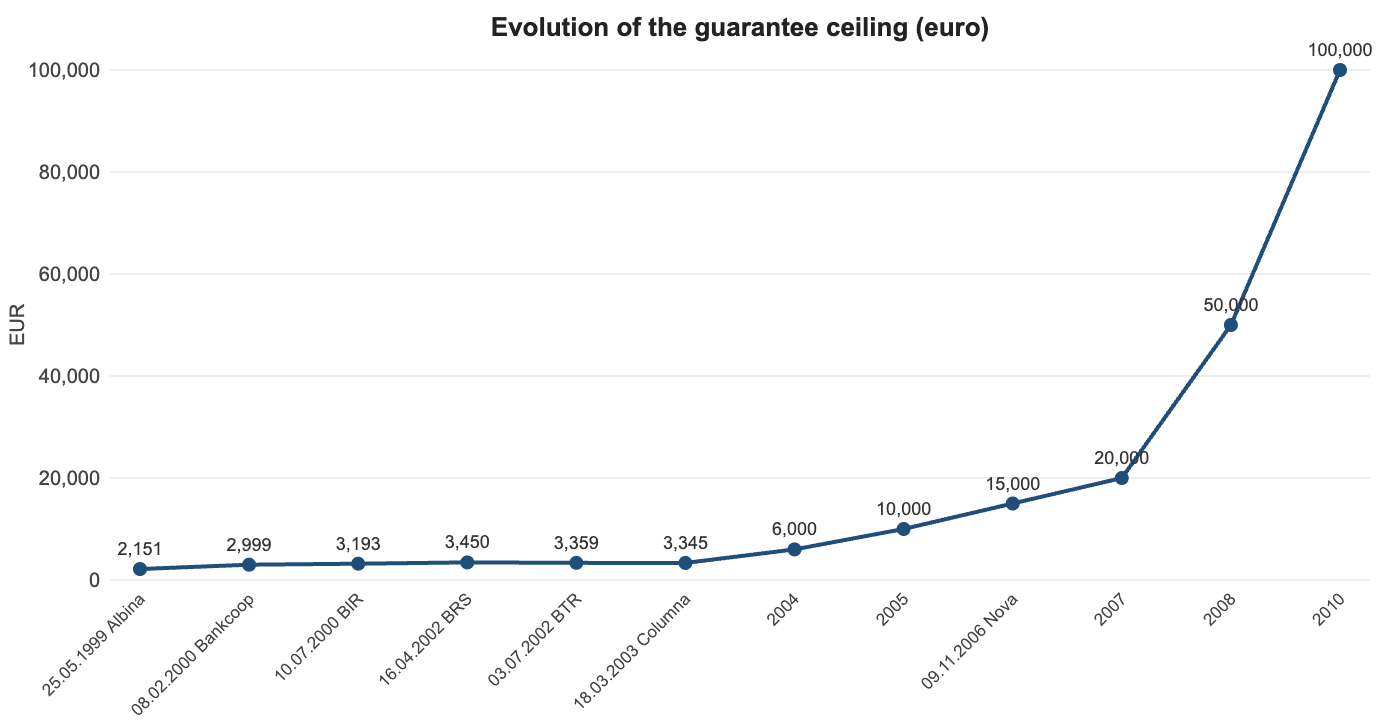
Shortly after its establishment, FGDB was confonted to its first compensation payments in 1999 to depositors of Banca Comercială “Albina.” The year 2000 posed a major challenge for FGDB, a relatively newly established institution, as it concentrated the bulk of the total compensation payments (over 90%) over the course of its existence. FGDB successfully passed this critical real test, which could have otherwise compromised its credibility in terms of both the securing of necessary resources and adherence to the statutory timeframe for starting the payouts. Given its limited own resources, FGDB utilized two credit lines granted by the National Bank of Romania, which were subsequently fully repaid using annual contributions from member credit institutions.
For each of the seven failed banks, FGDB provided compensations to eligible depositors over a three-year period starting from the date compensation payments began12. The majority of compensation payments were made within the first three months following the opening of bankruptcy, initially through mandated banks to act as paying agents (with an average payment duration of approximately two months) and subsequently directly by FGDB, with all compensations payment processes completed within the legal timeframe and without incidents.
None of the compensation payments involved the allocation of funds from the State budget.
Following the compensation payments, FGDB subrogated to the rights of the guaranteed depositors, becoming a creditor of the failed banks. FGDB’s status as a creditor ceased for six failed banks either through the full recovery of claims (Banca Română de Scont SA in 2004, Nova Bank SA in 2007 and Banca Turco Română SA in 2011) or through the closure of bankruptcy proceedings (Banca Comercială “Albina” in 2012, Bankcoop SA in 2019, and Banca “Columna” in 2022); currently, FGDB is the major creditor of Banca Internațională a Religiilor, whose bankruptcy proceedings are ongoing. As of June 30, 2026, FGDB had recovered claims arising from compensation payments and unpaid contributions totaling RON 186.5 million, with a recovery rate of 36.33% of the total claims of RON 513.3 million against the failed banks.
Public information and promotion through education
Public information is an essential factor for enhancing the awareness on depositors protection and maintaining the confidence in the banking system. As result, it is an important tool for any deposit guarantee scheme to achieve its objectives related to deposit protection and preserving the financial stability 13.
In line with international standards and best practices, raising public awareness about the role and functioning of the guarantee scheme is a key priority for FGDB. FGDB’s policy concerning public information has a broad scope that includes, apart increasing the awareness by using direct communication messages disseminated through different channels such as newspapers, the involvement in financial educations programmes and projects either alone or jointly with other institutions such as National Bank of Romania, Romania’s Banks Association and Romanian Banking Institute. Two examples where FGDB and National Bank of Romania cooperate on regular basis for promoting the financial education among children and teenagers are: (1) participating to so called financial education summer camps for teachers in secondary school where financial education is included in the curricula and (2) organizing the Eugeniu Carada contest for excellence in economy for teenagers in secondary school which is focusing on topics like macro-economy and financial stability.
As part of its educational outreach, FGDB organizes the contest “Costin Murgescu for economic research” which reached its XIVth edition in 2025. The contest aimed at excellence at academic level and the eligible participants are Romanian undergraduate, master’s and doctoral students. This prestigious event contributes both to the professional advancement of young specialists and to the promotion of the institution among professionals.
FGDB communication policy takes also into consideration more vulnerable categories such as people with low education level or people with different forms of disabilities. The actions undertaken by FGDB have been tailor-made in order to reachout the targeted categories. The toolkit includes, inter alia advertorials in high-circulation daily newspapers, clear messages delivered via accessible channels, online public information, education campaigns, contextual promotion via keywords, banners, using of local/regional communication channels etc.
Over time, FGDB’s activity has been guided by constant features, such as strengthening the deposit guarantee fund to ensure the fulfillment of its primary objective to protect depositors, developing and maintaining collaborative relationships with deposit guarantee schemes worldwide and other international entities and fostering the exchange of experience and the identification of industry’s best practices.
Since its establishment in 1996, the institution’s statutory responsibilities have become increasingly complex, enhancing its role within the national system for maintaining financial stability. Throughout this period, its upward trajectory, consistently supported by the National Bank of Romania, has shaped a dynamic institution capable of adapting to the public policy objectives that a deposit guarantee scheme must follow.
FGDB has fully demonstrated its importance and pivotal role in restoring and maintaining public confidence in the Romanian banking system by compensating depositors in a timely and orderly manner, without recourse to public funds. Consequently, depositor confidence – built over time through the percepetion of FGDB as an anchor of stability as well, alongside monetary policy, regulatory coherence, and the quality of banking supervision – has strengthened and continues to manifest itself by the sustainable growth of household savings. At the same time, FGDB has solidified its position as a safeguard for depositors, both by steadily and prudently increasing its financial resources, thereby ensuring now one of the highest coverage levels in the European Union and by establishing the infrastructure necessary to initiate compensation payments within just seven working days.
After 30 years, the founding values, professionalism, integrity, respect, and impartiality, did not need to be rediscovered, for they were never abandoned. Unlike the Homeric hero, the FGDB has no journey to conclude: each year of achieved stability is, in fact, a new voyage. Moreover, if the ultimate proof of a guarantee scheme’s success is the peace of mind of depositors, then the FGDB’s 30 years of activity find their most fitting measure herein.
The sea remains unpredictable and storms will inevitably rise again; FGDB’s role is to ensure that, come what may, the Romanian depositor never has to leave “Ithaca”.

- The pyramid schemes Mega-Caritas (1991-1994) and Gerald (1993-1994), the investment funds SAFI (1993-1996) and FNI (1995-2000) and the real estate leasing company MTS Leasing (2004-2005).
- Law No. 135 of October 28, 1996, regarding the authorization of the National Bank of Romania to grant loans to cover public’s requests for the withdrawal of bank deposits held at the banking companies “Dacia Felix” S.A. and “Credit Bank” S.A.
- The context for expanding FGDB’s role also included an external requirement imposed by the World Bank in 2000 as a condition for the disbursement of the second tranche under the Private Sector Adjustment Loan Agreement (PSAL II), with the reform program encompassing the expansion of FGDB’s mandate.
- Law No. 311/2015 on deposit guarantee schemes and the Bank Deposit Guarantee Fund, which transposed into national legislation the provisions of Directive 2014/49/EU of the European Parliament and of the Council of 16 April 2014 on deposit guarantee schemes.
- www.fgdb.ro
- Under the legislation in force, governing its operations since December 14, 2015, FGDB can no longer act as the judicial liquidator of credit institutions.
- The coverage limit of €100,000 per guaranteed depositor per credit institution applies in all European Union Member States and has been implemented in Romania since the end of 2010.
- The revised version of the Multilateral Cooperation Agreement has been signed by FGDB on September 15, 2025.
- European DGS to DGS Information Exchange System.
- 1999: Banca Comercială ”Albina” SA, bankruptcy proceedings closed in December 2012; 2000: Banca Generală de Credit și Promovare – Bankcoop SA, bankruptcy proceedings closed in November 2019, and Banca Internațională a Religiilor SA; 2002: Banca Română de Scont SA and Banca Turco Română SA; 2003: Banca ”Columna” SA, bankruptcy proceedings closed in May 2022; 2006: Nova Bank SA, bankruptcy proceedings closed in May 2020.
- The difference of RON 6.41 million was not claimed by 59% of the beneficiaries (470,353 individuals) due to the very low value of the individual compensation, approximately RON 14 lei.
- For the last bank failure recorded in Romania (Nova Bank SA), FGDB’s obligation to pay compensations ended in January 2010.
- IADI Core Principles for Effective Deposit Insurance Systems – The core principles for effective deposit insurance systems, published by IADI and the Basel Committee on Banking Supervision in June 2009 and revised in September 2025. Principle No. 10 (Public Awareness) concerns keeping the public constantly informed about the deposit insurance system.
ABOUT
- Anca Bud, ROCA Executive MBA student; Bank Deposit Guarantee Fund, Coordinator – Deposit Guarantee, Bank Resolution and Liquidation Department